Newborn Sleep by Month: What to Expect From Birth Through 6 Months
The honest, evidence-based guide new parents actually need at 3am

A tender midnight moment — the kind Tender Luv Nu-Born Care families know well.
It's 3am. Your newborn has been awake for what feels like the third time in two hours. You're exhausted, confused, and your phone screen is way too bright as you frantically type: "when do newborns sleep through the night?"
You find an answer. Then another answer that contradicts it. Then a forum thread that makes you feel like you're the only parent in the world whose baby isn't sleeping in a predictable pattern.
Take a breath. Close the tab. Read this instead.
This is the guide we give every family we work with at Tender Luv Nu-Born Care — an honest, evidence-based, month-by-month breakdown of what newborn sleep actually looks like, what's genuinely normal, and what you can do to protect your own rest in the meantime.
The most important thing before we begin: your baby is not broken. You are not failing. Newborn sleep is supposed to look chaotic. Here's why.
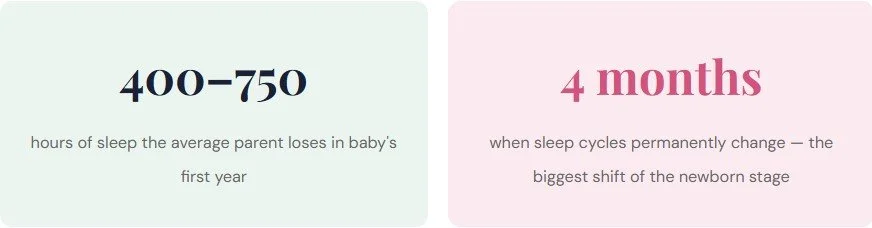
Why Newborn Sleep Looks Nothing Like Adult Sleep
Before we go month by month, let's understand the biology — because once you understand it, the 3am chaos makes a lot more sense.
Adult sleep happens in long cycles of 90 minutes, moving from light sleep through deep sleep and REM. Newborn sleep cycles are much shorter — about 45 to 50 minutes — and spend proportionally far more time in REM (active) sleep, which is essential for rapid brain development.
This means newborns cycle between sleep states more frequently. They rouse more easily. They transition through light sleep more often. And because their stomachs are tiny — holding only about 1–2 oz at birth — they genuinely need to eat frequently, around the clock.
None of this is a problem. All of it is exactly what a healthy, developing newborn brain and body is supposed to do.

Newborn Sleep by Month: The Honest Guide
Use this as your reference guide — not a rigid schedule. Every baby develops at their own pace. These are ranges, not rules.
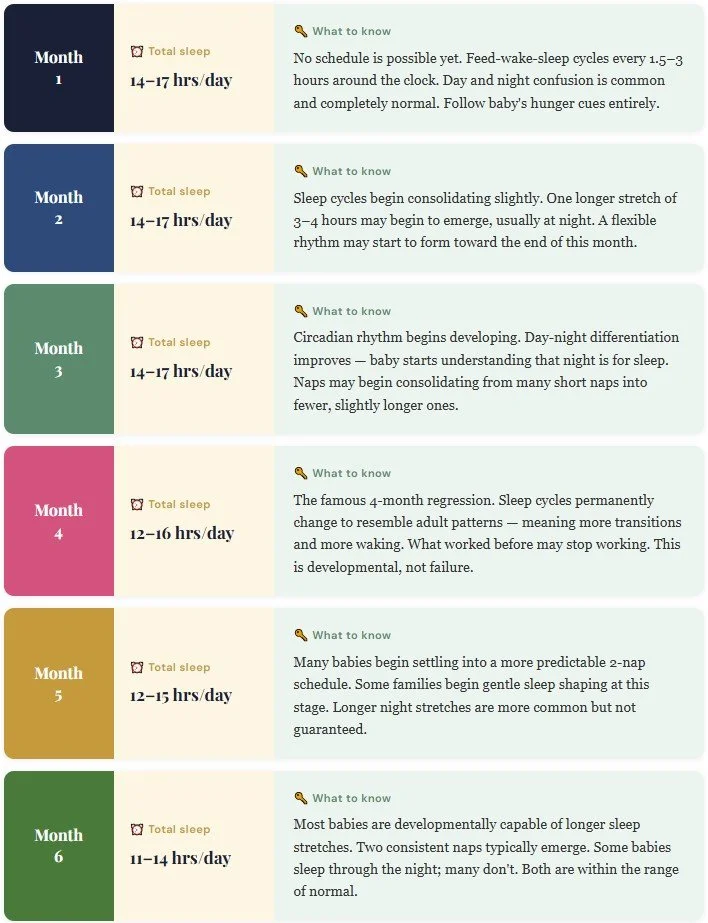
The 4-Month Sleep Regression: What It Is and Why It Happens
If there is one milestone in newborn sleep that parents are never prepared for, it's the 4-month regression. We dedicate an entire section to it because it is the most common reason families reach out to us in a panic.
Here's the most important thing to understand: the 4-month sleep regression is not actually a regression. It's a permanent developmental change in how your baby's brain processes sleep.
Before 4 months, newborns cycle between just two sleep states — active sleep and quiet sleep. Around 4 months, their sleep architecture permanently shifts to the adult pattern: light sleep, deep sleep, and REM in rotating cycles, each with a brief arousal at the end.
Those brief arousals are completely normal in adults — we barely notice them. But a baby who has learned to fall asleep at the breast or in your arms will fully wake up at each cycle transition and signal for the same conditions they started sleep with. That's the regression.
What the 4-Month Regression Looks Like
Baby who was sleeping 4–6 hour stretches suddenly wakes every 45–90 minutes
Naps that were getting longer suddenly become shorter again
Baby is harder to settle and requires more support to fall back to sleep
Increased fussiness, especially in the evenings
Feeding more frequently — often due to overtiredness as well as growth
How Long Does It Last?
The regression itself typically peaks between 3 and 6 weeks. If sleep remains fragmented beyond 8 weeks, it's usually because sleep associations have formed that need to be gently addressed — with professional guidance if needed.

Sleep Associations: What They Are and Why They Matter
A sleep association is whatever condition your baby has learned to need in order to fall asleep — and critically, to return to sleep between cycles. Common ones include nursing, bottle feeding, being rocked or bounced, being held, or a parent's presence.
Sleep associations themselves are not bad. In the early weeks and months, they are not only appropriate — they are biologically expected. Newborns are designed to need close contact to feel safe.
The time to gently consider sleep associations is typically around 4–6 months, when your baby's sleep architecture has matured enough that they have the neurological capacity to connect sleep cycles independently — if they've had the opportunity to practice.
Signs Your Baby Is Getting Enough Sleep
Signs Baby Is Rested ✓
Happy and engaged during wake windows — alert, curious, interactive
Feeding well and gaining weight appropriately
Falls asleep relatively easily at nap and bedtime (with support if needed)
Reaches developmental milestones within normal ranges
Overall contentment during awake periods
Signs Baby May Be Overtired ⚠️
Extreme fussiness and difficulty settling that seems disproportionate
Short, fragmented naps that don't seem restorative
Very early morning waking (before 6am consistently)
Falling asleep immediately upon any motion — car, stroller, carrier
Rubbing eyes, pulling ears, arching back — very late overtired cues
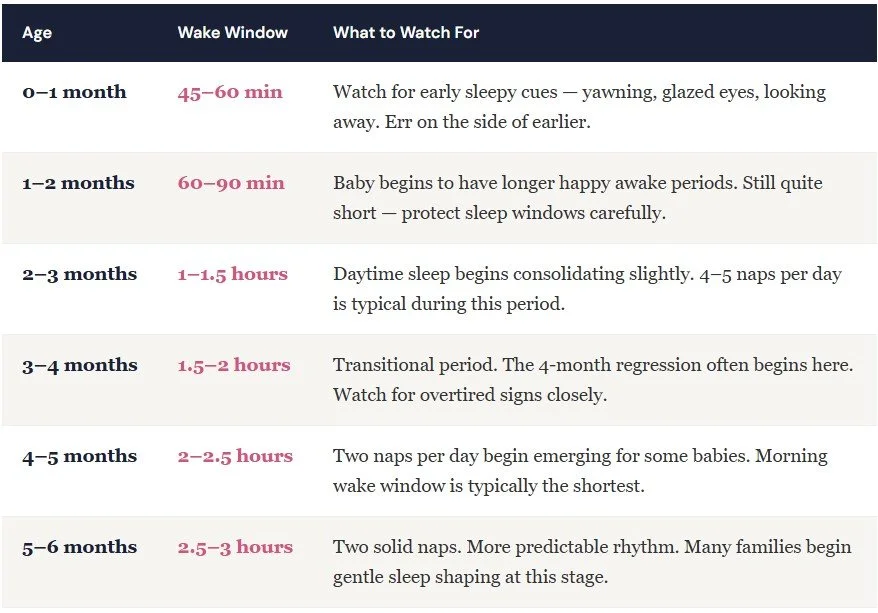
Age-Appropriate Wake Windows at a Glance
Wake windows are the amount of awake time your baby can comfortably handle between sleep periods. Exceeding them leads to overtiredness; keeping within them leads to easier settling.
The Part Nobody Talks About: Your Sleep Matters Too
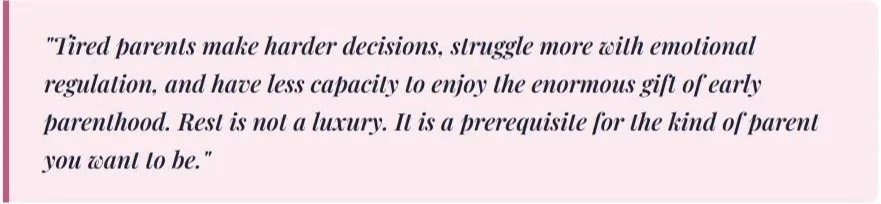
We can spend an entire article talking about baby sleep patterns, and we have. But the conversation is incomplete if we don't address the other side: what happens to parents who aren't sleeping.
Postpartum sleep deprivation is not a badge of honor. It is a medical condition. Research consistently links severe sleep deprivation to:
Increased rates of postpartum depression and anxiety
Impaired physical recovery from birth
Reduced milk supply in breastfeeding mothers
Significant relationship strain between partners
Impaired judgment and reaction time — a genuine safety concern for a parent caring for a newborn
Reduced capacity for emotional attunement with your baby
None of this is your fault. And all of it is addressable.

Practical Ways to Protect Your Sleep
Sleep when baby sleeps — and mean it. Not scroll. Not reply to emails. Sleep.
Split night shifts with your partner so each person gets a protected sleep block of 4+ hours
Accept every offer of help that allows you to rest
Lower your threshold for what constitutes a "done" home — the laundry can wait
Consider overnight newborn care support — the single most effective intervention for parental sleep in the fourth trimester
How Overnight Newborn Care Changes Everything
At Tender Luv Nu-Born Care, overnight newborn care is the service families tell us changed their entire postpartum experience.
When one of our overnight care specialists arrives at your home, you go to sleep. We handle every feed, every settling, every diaper change. We track feeding times, diaper output, and sleep cycles in a detailed log for your pediatrician. We notice any health concerns and share them with you in the morning. We sterilize bottles, tidy the feeding station, and leave you set up for the day.
You sleep for 6 to 8 uninterrupted hours.
Most parents who experience one overnight shift describe it as transformative. Not because we fixed their baby's sleep. But because they woke up rested — and remembered what it felt like to be a full human being again

— Postpartum client, Silver Lake, Los Angeles
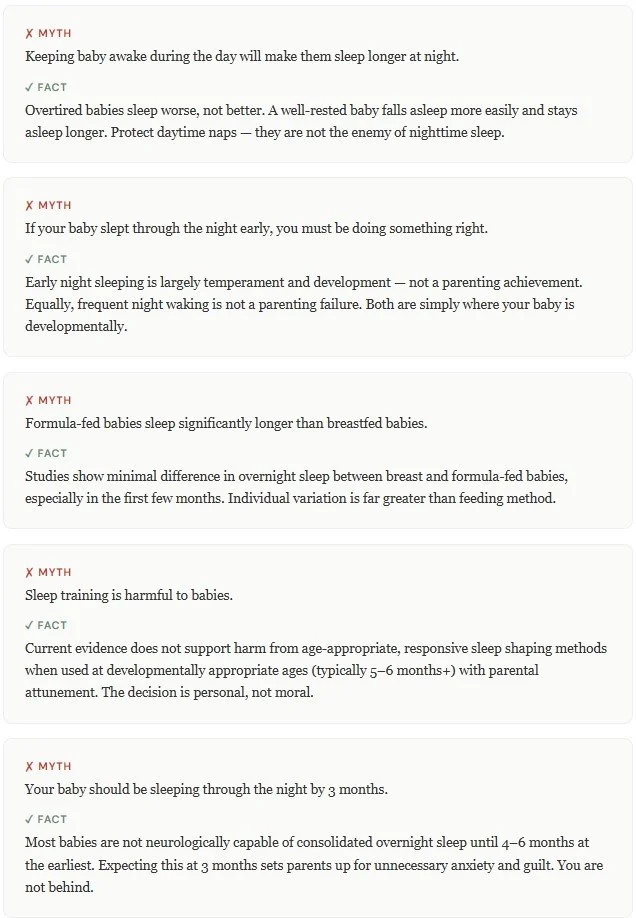
5 Newborn Sleep Myths — Debunked
When to Talk to Your Pediatrician About Baby's Sleep
Most newborn sleep challenges are developmental and do not require medical attention. However, reach out to your pediatrician if:
Your baby seems consistently difficult to rouse or unusually sleepy during expected wake windows
Baby is not feeding adequately — below the recommended number of feeds for their age
Baby is not gaining weight appropriately
You notice changes in breathing during sleep — irregular pauses, labored breathing, or unusual sounds
Baby seems in discomfort — arching, pulling legs up, inconsolable crying that may indicate reflux
Your own sleep deprivation is affecting your mental health or your ability to safely care for your baby
That last one is important. Your wellbeing is a medical matter, not a personal failing. If sleep deprivation is affecting your mood, functioning, or safety — please ask for help.
The Bottom Line
Newborn sleep is not a problem to be solved. It is a biological process to be understood and supported.
Your baby is sleeping the way babies are designed to sleep. And you deserve support that allows you to get through this season rested, healthy, and present enough to enjoy it.
Month by month, the sleep will change. The stretches will lengthen. The patterns will emerge. And one day — probably sooner than the internet tells you — you will look back at the 3am feeds and feel something complicated and warm about them.
Until then: you are not alone. We are here. Every overnight shift, every tired morning, every question you have at 2am.
Rest is coming. Let us help you get there.