
Bringing Your Baby Home from the NICU: A Guide to Your First Days Together

Discharge day can bring relief, excitement, uncertainty—or a quiet sense that you are finally ready. There is no single way a NICU homecoming should feel.
Some families settle in peacefully. Others need time to feel comfortable away from the hospital team. Your experience may change from one day to the next.
Bringing your baby home from the NICU is a new chapter in getting to know each other. You do not need to recreate the hospital at home or follow someone else’s emotional timeline. You need clear instructions for your baby, people you can call, and support that fits your family.
During September’s NICU Awareness Month—and throughout the year—Tender Luv Nu-born Care honors every family’s journey. Here is a practical starting point for the transition home.
This article provides general education. Your baby’s discharge instructions and medical team should guide their individual care.
1. Leave with a plan you understand
Before discharge, ask the team to explain what care your baby needs at home. If something is unclear, ask them to demonstrate it again, then practice while they are available.
Keep your discharge summary, medication instructions, contact numbers, and appointment details in one accessible place. If your baby needs prescribed equipment, make sure every responsible caregiver knows how to use it and whom to contact if it stops working.
The American Academy of Pediatrics encourages families to discuss home-care needs with the NICU team before leaving. Read the AAP’s NICU home-care guidance .
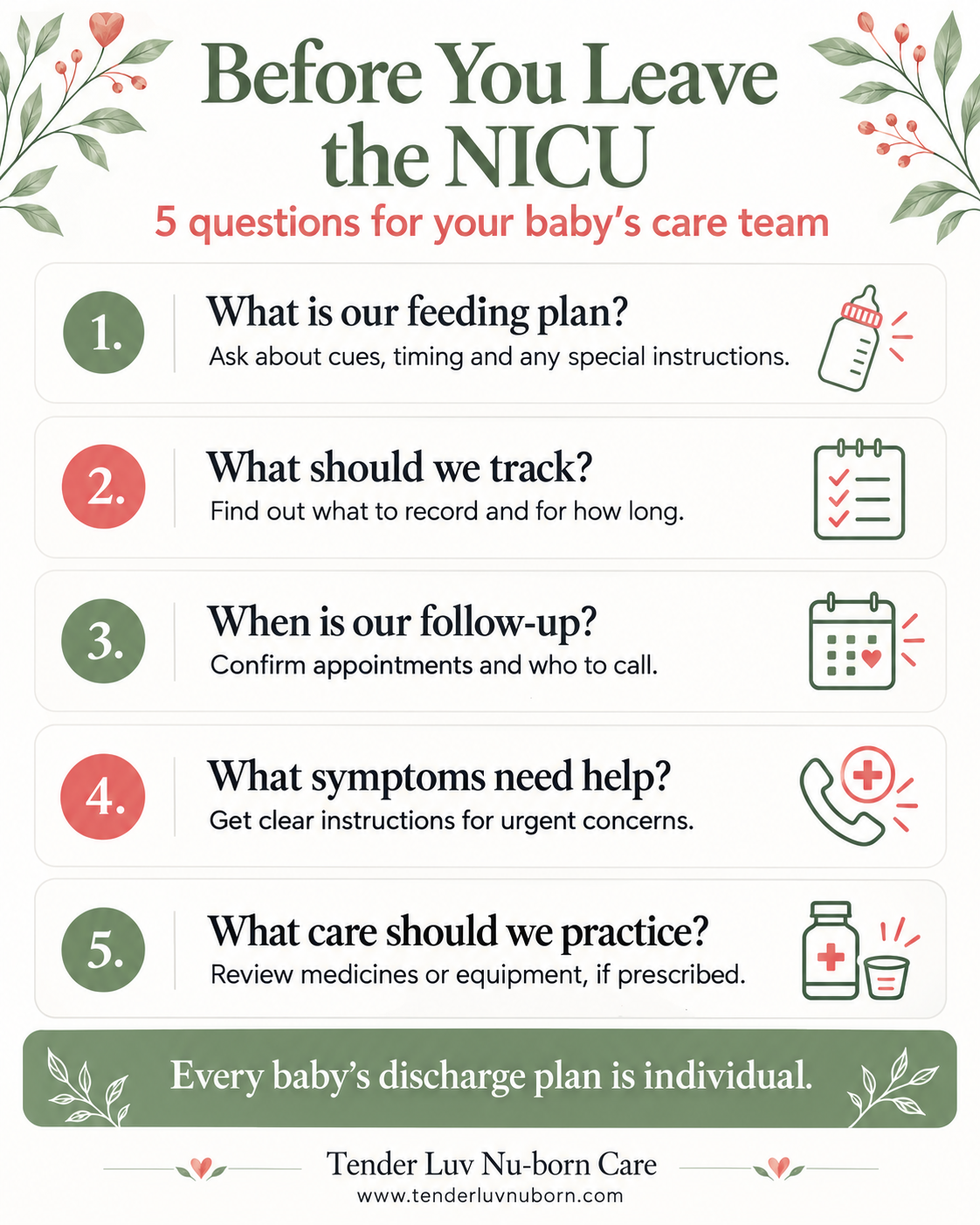
Useful questions include:
What is our baby’s feeding plan?
What, if anything, should we record at home?
When is the first follow-up appointment?
Who should we call during the day and after hours?
What symptoms mean we need urgent help?
What care should we practice before discharge?
Ask for an interpreter or written instructions in your preferred language when needed. Understanding the plan matters more than remembering everything the first time.
2. Let your baby’s individual feeding plan guide you
There is no universal feeding schedule for every baby leaving the NICU.
Ask how your baby’s hunger and fullness cues fit with their discharge instructions. Clarify whether there is a maximum time between feeds, whether you should wake your baby, and whether there are specific instructions about amounts or feeding methods.
Some premature babies need extra calories through prescribed fortification or a particular formula. Follow the preparation instructions you are given, and ask the medical team before changing them. The AAP explains that premature babies can have special nutritional and feeding needs. Read the AAP’s premature-baby feeding guidance.
If you are breastfeeding or pumping, ask how lactation support will fit into your baby’s follow-up care. Feeding concerns may also need input from the pediatrician, dietitian, or feeding therapist.
Logging is another question to individualize. Ask what information the team needs, how often to record it, and when you can stop. A simple record may be useful when requested; detailed hospital-style documentation is not a requirement for every family.
Your goal is a feeding approach that meets your baby’s needs and that you understand well enough to carry out at home.
3. Prepare a simple, safe place to settle in
You do not need a picture-perfect nursery. Start with the essentials: a safe sleep space, feeding supplies, diapering supplies, and any items included in your discharge plan.
For sleep, place your baby on their back on a firm, flat, level mattress in a safety-approved crib, bassinet, or play yard. Use only a fitted sheet. Keep pillows, loose blankets, stuffed animals, bumpers, and positioners out of the sleep space.
Share your room rather than your bed, ideally for at least the first six months. Practices you may have seen under close monitoring in the NICU are not automatically appropriate for home. Ask the team to show you the home sleep setup before discharge. See NIH Safe to Sleep recommendations.
Keep the discharge contact information somewhere every caregiver can find it. Save important numbers in your phone, too. Having them ready can make a question easier to act on.
4. Choose help that makes your day easier
Support can be small and specific. Someone could bring dinner, wash dishes, drive you to an appointment, or spend time with an older child.
Instead of feeling responsible for hosting visitors, tell people what would actually help:
“Could you leave dinner at the door on Tuesday?”
“We would love help with laundry this week.”
“We’re keeping visits short while we settle in.”
Discuss visitor and illness precautions with your baby’s team, especially if your baby has additional medical needs. You can welcome company or ask for quiet time without having to defend your preference.
If you are considering professional support, explain your baby’s care needs before booking. Ask about relevant experience, scope of practice, and how the caregiver will follow your discharge instructions. Medical procedures and equipment require the appropriately trained professionals specified by your clinical team.
A helpful caregiver should listen to your family’s preferences and support the plan you have been given.
5. Make room for your own adjustment
You may feel happy, tired, unsettled, confident, or several things at once. You may also feel better at home than you did in the hospital. None of these experiences needs to match another parent’s story.
Try to make room for food, rest, and a conversation that is about you as well as your baby. A partner, friend, relative, or peer-support group can offer connection without expecting you to explain everything perfectly.
If sadness, anxiety, hopelessness, or difficulty functioning is persistent or intense, contact your healthcare professional. You do not need to wait for symptoms to become severe. Perinatal depression is treatable, and professional support can help. Learn about symptoms and treatment from NIMH.
In the United States, call or text 988 for a mental health crisis. Call 911 for immediate danger. The National Maternal Mental Health Hotline, 1-833-852-6262, also offers free, confidential support.
6. Stay connected to your baby’s care team
Keep follow-up appointments and bring your questions. Ask who is coordinating care if your baby sees several specialists.
Before leaving the hospital, get clear instructions for symptoms that need a same-day call, urgent assessment, or emergency care. If you are unsure how to interpret a change at home, contact the team rather than waiting for a social-media answer.
You do not have to become an expert overnight. Knowing when and how to ask for help is part of caring for your baby.
Support for your family in Los Angeles
Your first days at home belong to your family. They can include joy, learning, rest, and questions without following a strict timetable.
At Tender Luv Nu-born Care, we welcome families of every culture, ethnicity, background, and family structure. Contact us to discuss postpartum and newborn support that fits your household and complements your baby’s medical care.
Preparing for a NICU homecoming in Los Angeles? Let’s talk about the support your family needs.
Call (323) 304-6770 Email: roxanne@tenderluvnuborn.com, or visit www.tenderluvnuborn.com
Nurturing Mothers. Supporting Families. Honoring Every Journey.